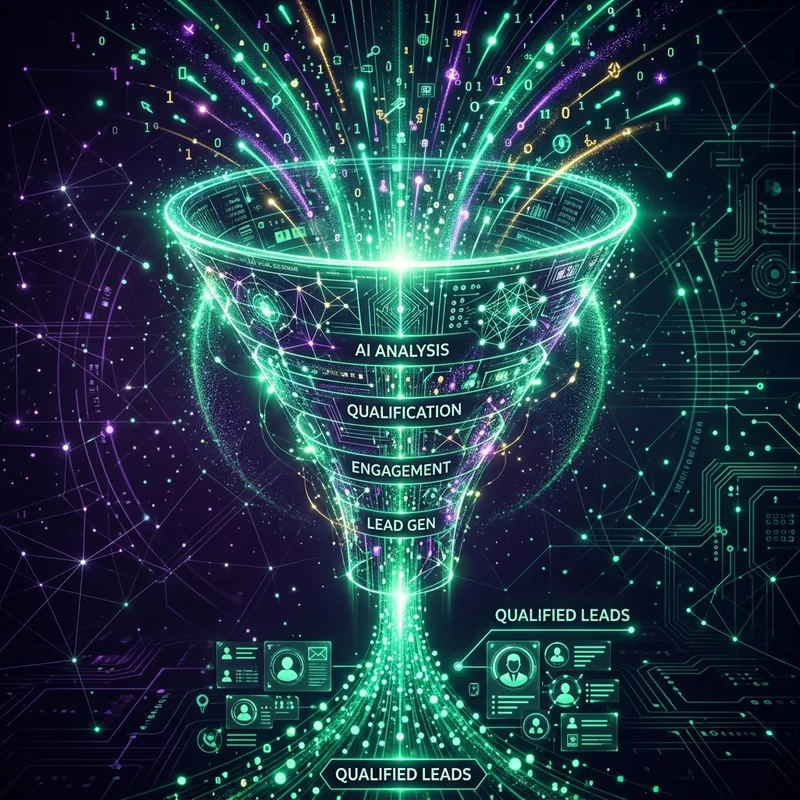
If your sales team is still manually researching prospects, writing cold emails one by one, and chasing leads through spreadsheets — you're already behind.
The businesses growing fastest in 2026 are running AI-driven lead generation systems that work 24 hours a day, research every prospect automatically, write personalised outreach at scale, and log everything to a CRM without a human touching it.
This guide breaks down exactly how it works, what tools you need, and how to build it — whether you're a solo founder or running a sales team of ten.
Why the Old Lead Generation Playbook Is Dead
Three years ago, cold email worked because inboxes were less crowded and buyers were more patient. Neither is true today.
The average business decision-maker receives 120+ emails per day. Generic outreach — "Hi [First Name], I noticed you work at [Company]..." — gets deleted in under two seconds. Reply rates on untargeted cold email campaigns have dropped below 1% industry-wide.
The problem isn't cold outreach itself. The problem is doing it without intelligence.
AI-driven lead generation fixes this by replacing volume with precision. Instead of emailing 1,000 random prospects and hoping 10 reply, you identify the 50 prospects most likely to buy right now, research each one automatically, and send a message that feels like it was written by someone who spent an hour on their LinkedIn profile — because an AI did exactly that.
What AI-Driven Lead Generation Actually Looks Like
Here is the full system, end to end, the way high-performing sales teams run it in 2026.
Step 1: Intelligent Prospect Sourcing
The first step is building a list of prospects that actually match your ideal customer profile — not a scraped list of job titles, but a filtered set of companies showing buying signals right now.
Buying signals include: recent funding announcements, new hire patterns (hiring a Head of Operations signals scaling pain), tech stack changes, job postings that mention tools you integrate with, and LinkedIn activity showing the prospect is actively researching your space.
Tools for this: Apollo.io, Clay, LinkedIn Sales Navigator, and n8n workflows that pull and filter data automatically on a schedule.
Step 2: AI Enrichment
Once you have a prospect list, each entry goes through an enrichment workflow. This is where AI does the heavy lifting.
An n8n workflow pulls each prospect's company URL, LinkedIn profile, and recent news. It passes this data to GPT-4 or Claude with a prompt like: "Based on this company's recent activity, what are their top 3 operational pain points relevant to workflow automation? Format as JSON."
The structured output — pain points, relevant context, personalisation hooks — gets written back to your CRM automatically. Every prospect now has a research dossier that would have taken a human researcher 30 minutes to compile.
Step 3: Personalised Message Generation
With enrichment data in your CRM, a second AI step generates the outreach message.
The prompt feeds in the prospect's name, company, role, pain points, and a description of what you offer. GPT-4 writes a first line that references something specific — a funding round, a recent LinkedIn post, a job listing — then transitions into a relevant value proposition.
Every message is unique. Open rates on AI-personalised outreach run 40–60% versus 20–25% for generic campaigns. Reply rates typically double.
Step 4: Automated Sequencing and Follow-Up
The personalised message goes into an automated sequence. Day 1: initial outreach. Day 3: value-add follow-up (share a relevant article or case study). Day 7: break-up email.
n8n handles the sequencing logic — checking for replies, pausing sequences when a prospect responds, logging all activity to your CRM, and alerting your sales team in Slack the moment a positive reply lands.
No human involvement until there is a live conversation to have.
The Tools You Need (And What Each One Does)
You do not need an expensive enterprise stack. Here is the lean version that works for most businesses:
Apollo.io or Clay — prospect sourcing and initial data. Apollo has a built-in database of 275M+ contacts with filtering by title, company size, tech stack, and funding. Clay goes deeper with custom enrichment waterfalls.
n8n — the automation backbone. Connects every tool, runs enrichment workflows on a schedule, sequences outreach, and logs everything. Self-hostable for under $20/month on a VPS.
OpenAI GPT-4 or Claude — the AI layer for enrichment and personalisation. Called via API inside n8n workflows. Cost per enriched prospect: under $0.05.
HubSpot (free tier) — CRM to store enriched prospects and track sequence activity.
Instantly or Smartlead — cold email sending infrastructure with inbox rotation and deliverability tools.
Total monthly cost for this stack: under $300. A single SDR costs $4,000–6,000 per month and works 8 hours a day.
The 3 Mistakes That Kill AI Lead Generation Systems
Mistake 1: Automating before validating your ICP
If you do not have a clear ideal customer profile — specific industry, company size, role, and pain point — AI will generate perfectly written emails to the wrong people. Garbage in, garbage out. Spend a week defining your ICP from your best existing customers before building any automation.
Mistake 2: Skipping deliverability setup
The most personalised email in the world does not matter if it lands in spam. Before running any cold email campaign, set up SPF, DKIM, and DMARC on your domain. Use a separate sending domain (not your main business domain). Warm up new inboxes for 2–3 weeks before sending at volume.
Mistake 3: Not closing the loop into your CRM
Every enriched prospect, every sent message, every reply, and every booked meeting needs to be logged automatically. If this data lives in spreadsheets or in someone's head, you cannot improve the system. Build the CRM logging into the n8n workflow from day one.
How to Build This in n8n — The Workflow Architecture
The core workflow has four nodes in sequence:
Trigger: Schedule node runs daily at 6am. Pulls new prospects from Apollo or Clay via HTTP node.
Enrich: Each prospect passed to OpenAI node with enrichment prompt. Structured output written back via HubSpot node.
Generate: Second OpenAI node takes enrichment data and generates personalised email copy. Output stored in CRM.
Send: HTTP node calls your email sending API (Instantly or Smartlead) with the personalised message. Sequence logic handles follow-ups.
The entire workflow runs unattended. Your sales team wakes up to a Slack notification listing prospects who replied overnight.
If you want to skip the build time, our Client Onboarding Automation template includes the n8n workflow architecture for prospect management and automated follow-up sequences — ready to import and customise in under an hour.
👉 Get the Client Onboarding Automation Template → https://flowmindstore.com/templates/client-onboarding-automation-n8n
What Results to Expect in 30 Days
Week 1: System setup and ICP definition. No outreach yet.
Week 2: First 50 prospects enriched and sequenced. Expect 0–3 replies — this is normal. You are calibrating messaging.
Week 3: Iterate on the first line and value proposition based on reply data. Add 100 more prospects. Reply rate should improve.
Week 4: System running smoothly. 150+ prospects in sequence. Expect 5–15 positive replies depending on your niche and offer.
Most businesses see their first AI-generated meeting booked within 14–21 days of launching. The system gets better every week as you refine the enrichment prompts and personalisation logic.
Quick Summary
- AI lead generation replaces manual research and generic outreach with automated, personalised, signal-based prospecting
- The core stack is Apollo or Clay + n8n + GPT-4 + HubSpot + Instantly — under $300/month total
- The four steps are: prospect sourcing, AI enrichment, personalised message generation, automated sequencing
- Common mistakes are skipping ICP definition, ignoring deliverability, and not logging to a CRM
- Most teams see first booked meetings within 14–21 days of launching
Ready to automate your outreach? Browse FlowMind's n8n workflow templates — including client onboarding, lead management, and AI-powered communication workflows.
👉 Browse n8n Templates on FlowMind → https://flowmindstore.com/templates/n8n
This article is part of our AI business automation playbook.